
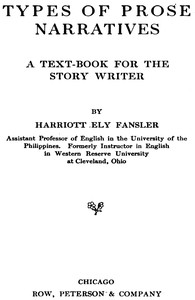
Types of Prose Narratives: A Text-Book for the Story Writer by Harriott Ely Fansler
Let's be clear from the start: this is a textbook. Published in 1915, Harriott Ely Fansler's book was designed for students learning the craft of writing. But don't let that scare you off. It's structured as a clear, methodical guide that walks you through the different forms a story can take.
The Story
There isn't a plot in the traditional sense. Instead, the 'journey' is one of understanding. Fansler starts with the smallest building blocks, like character sketches and brief anecdotes. She then moves through more complex forms: short stories, novelettes, and finally, the novel. For each type, she explains its purpose, its typical structure, and what makes it effective. She constantly uses examples from authors like Hawthorne, Dickens, and Poe to illustrate her points. Think of it as a behind-the-scenes tour of narrative architecture, where she points out the load-bearing walls and the decorative flourishes, showing you how they all fit together to create a solid, engaging piece.
Why You Should Read It
What makes this book special is its voice. Fansler writes with a direct, practical, and surprisingly modern sensibility. She's not interested in flowery language or abstract theory. She wants to know what works and why. Reading her analysis feels like having a candid workshop with a very experienced editor. Her insights into character motivation and plot structure are timeless. You'll find yourself nodding along, thinking about modern novels or movies and seeing the same principles at play. It demystifies the writing process in a way that is both humble and incredibly confident.
Final Verdict
This book is perfect for aspiring writers who want foundational advice without the fluff, and for curious readers who love dissecting how a story achieves its effect. It's not a quick, trendy writing guide; it's a classic, sturdy manual. If you enjoy seeing the gears and cogs behind a great narrative, you'll find Fansler's clear-eyed tour absolutely fascinating. Just be prepared to look at every story you read next a little differently.
The copyright for this book has expired, making it public property. You can copy, modify, and distribute it freely.
Amanda Allen
10 months agoGreat read!
James Thompson
1 year agoI came across this while browsing and the narrative structure is incredibly compelling. I will read more from this author.





Deborah Harris
2 years agoFive stars!